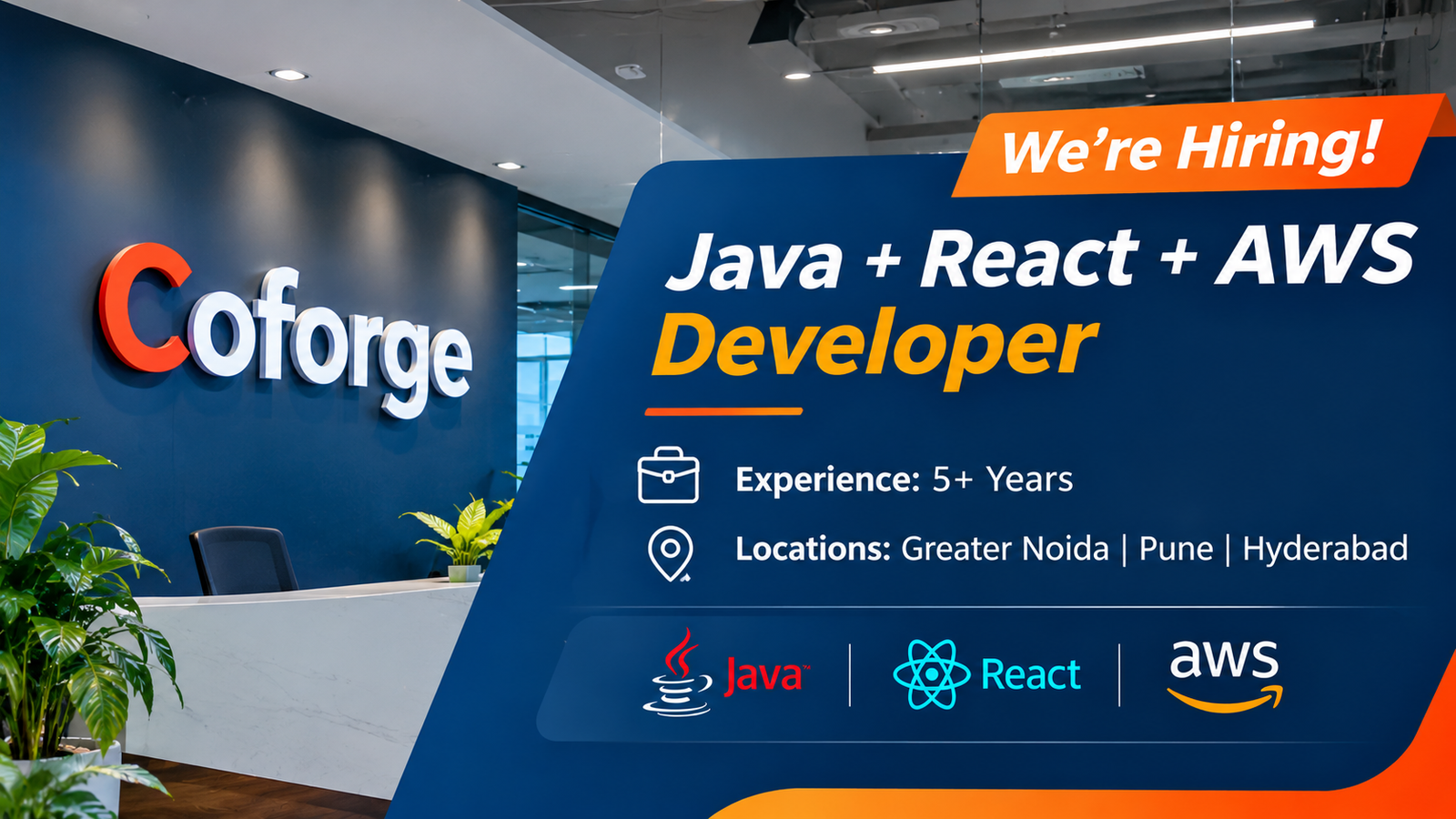
Python GenAI Lead at Coforge Ltd | Hyderabad / Pune / Noida
Coforge Ltd is actively hiring a Python GenAI Lead for mid-to-senior level professionals with 6–10 years of experience. This is a high-impact role focused on designing and building next-generation AI solutions powered by Generative AI, Large Language Models (LLMs), and Autonomous AI Agents. If you’re a Python expert with hands-on experience in LangChain, vector databases, and prompt engineering, and you’re ready to mentor teams while driving GenAI innovation, this opportunity aligns perfectly with your career growth. Join thousands of job seekers receiving free daily alerts—subscribe to our WhatsApp Channel and Telegram Channel for exclusive job postings, referral opportunities, and walk-in alerts.
Table of Contents
- Job Details
- About Coforge Ltd
- Job Description
- Eligibility Criteria
- Key Responsibilities
- Required Skills
- Who Can Apply
- How to Prepare
- Frequently Asked Questions
- How to Apply
- Stay Updated — Free Job Alerts
- Disclaimer
Job Details
| Field | Value |
|---|---|
| Company | Coforge Ltd |
| Job Title / Role | Python GenAI Lead |
| Experience Required | 6–10 Years |
| Qualification | B.Tech / M.Tech (Computer Science, IT, or related discipline preferred) |
| Location | Hyderabad / Pune / Noida |
| Salary / CTC | As per company standards |
| Work Model | As per company standards |
| Job Type | Full-time |
| Application Deadline | As per company standards |
About Coforge Ltd
Coforge Ltd is a leading global IT services and digital transformation company headquartered in India. Known for delivering enterprise-grade solutions across cloud, AI, analytics, and digital platforms, Coforge partners with Fortune 500 and mid-market enterprises to drive innovation and operational excellence. The company has a strong track record in emerging technology adoption, including Generative AI, machine learning, and autonomous systems. Coforge’s commitment to building cutting-edge GenAI solutions positions it as a trusted advisor for organizations navigating the AI-driven transformation wave. With multiple delivery centers across India and globally, Coforge offers a collaborative environment where technical leaders can mentor teams, architect complex solutions, and shape the future of AI innovation.
Job Description
As a Python GenAI Lead, you will take ownership of designing and building next-generation AI solutions that leverage Generative AI, Large Language Models (LLMs), and Autonomous AI Agents. This is not a pure coding role—it’s a technical leadership position where you will architect intelligent systems, define GenAI best practices, and guide engineering teams through complex implementation challenges. You will work with cutting-edge frameworks like CrewAI, LangGraph, and AutoGen to design autonomous agents that can reason, plan, and execute tasks with minimal human intervention.
Your responsibilities extend beyond development: you’ll implement advanced NLP techniques such as Retrieval-Augmented Generation (RAG), optimize vector database interactions (Pinecone, ChromaDB, Weaviate), and refine prompt engineering strategies to maximize model performance. You’ll also serve as a knowledge hub within your organization, establishing GenAI patterns, best practices, and architectural guidelines that elevate team capability and solution quality.
This role demands both technical depth in Python and AI frameworks and soft leadership skills to mentor mid-level engineers, articulate GenAI concepts to non-technical stakeholders, and drive adoption of emerging AI tools. If you have 6–10 years of solid Python experience and hands-on exposure to modern GenAI frameworks, this is an exceptional opportunity to transition into a technical leadership track while shaping innovation at a global scale.
Eligibility Criteria
- Education: B.Tech / M.Tech in Computer Science, Information Technology, or a related discipline (preferred); equivalent industry experience with strong technical certifications also considered.
- Experience: Minimum 6–10 years in software development, with at least 1–2 years of hands-on experience with Generative AI, LLMs, or related AI/ML projects.
- Mandatory Skills (Must-Have):
- Python (advanced proficiency; experience building production systems)
- Generative AI and Large Language Models (hands-on experience with OpenAI, Anthropic, or open-source models)
- LangChain (framework design and implementation)
- Vector databases (Pinecone, ChromaDB, or Weaviate)
- REST API design and integration
- Git version control and CI/CD pipelines
- Preferred Skills (Nice-to-Have):
- Azure OpenAI or AWS Bedrock (cloud-hosted GenAI models)
- Google Vertex AI
- Docker containerization
- Kubernetes orchestration
- CrewAI, LangGraph, or AutoGen frameworks
- Prompt engineering and RAG implementation
- Soft Skills: Strong communication, mentoring ability, problem-solving mindset, and comfort working in cross-functional teams.
Key Responsibilities
- Architect Autonomous AI Agents: Design intelligent, autonomous agents using CrewAI, LangGraph, AutoGen, and LangChain that can independently plan, execute, and iterate on complex tasks.
- Implement Retrieval-Augmented Generation (RAG): Build end-to-end RAG pipelines that combine LLM reasoning with external knowledge bases, ensuring accurate and contextual AI responses.
- Optimize Vector Database Integration: Configure, manage, and optimize vector databases (Pinecone, ChromaDB, Weaviate) for semantic search, similarity matching, and knowledge retrieval at scale.
- Refine Prompt Engineering Strategies: Develop, test, and document prompt templates that maximize LLM output quality, consistency, and alignment with business objectives.
- Mentor and Guide Teams: Provide technical leadership to mid-level engineers, conduct code reviews, and foster a culture of continuous learning around GenAI technologies.
- Establish GenAI Best Practices: Define architectural patterns, coding standards, and deployment guidelines for GenAI solutions across projects and teams.
- Collaborate with Stakeholders: Translate business requirements into technical specifications, and communicate AI capabilities and limitations to non-technical teams and clients.
- Drive Integration with Cloud Platforms: Integrate GenAI solutions with Azure OpenAI, AWS Bedrock, Google Vertex AI, or other cloud services to build scalable, enterprise-grade applications.
Required Skills
- Python (Advanced): Production-grade proficiency in building scalable, maintainable systems. Experience with async programming, testing frameworks, and performance optimization is essential.
- Generative AI & LLMs: Hands-on experience with models from OpenAI, Anthropic, or open-source alternatives. Understand fine-tuning, in-context learning, and model selection strategies.
- LangChain: Deep familiarity with LangChain’s architecture, including chains, agents, memory management, and integration with external tools and APIs.
- Vector Databases (Pinecone / ChromaDB / Weaviate): Proficiency in embedding storage, similarity search, and retrieval optimization. Experience managing vector data at scale is a plus.
- REST API Design & Development: Ability to design and implement RESTful APIs that expose AI models and integrate with downstream applications.
- Git & Version Control: Fluent in Git workflows, branching strategies, and collaborative development practices.
- CI/CD Pipelines: Experience setting up automated testing, deployment, and monitoring using Jenkins, GitHub Actions, GitLab CI, or equivalent tools.
- Problem-Solving & Systems Thinking: Ability to break down complex AI problems, evaluate trade-offs, and design robust, scalable solutions.
- Communication & Mentoring: Strong verbal and written communication; ability to explain technical concepts clearly and mentor junior engineers effectively.
Who Can Apply
This role is designed for mid-to-senior level engineers with a strong foundation in Python and proven experience in AI/ML or emerging technologies. You should have demonstrated technical leadership—either formally (as a team lead or senior engineer) or informally (mentoring peers, architecting solutions). This is not suitable for freshers or early-career professionals without 4+ years of software engineering experience; however, engineers with 6–8 years of backend/full-stack experience and 1–2 years of GenAI project work are ideal candidates.
- Ideal Profile: A Python engineer transitioning from backend, data engineering, or AI/ML roles into GenAI-focused technical leadership.
- Domain Fit: Startups, scale-ups, and enterprises investing heavily in GenAI; anyone passionate about autonomous systems and next-generation AI applications.
- Career Stage: Mid-level engineers (6–8 YoE) aiming for staff/principal roles, or senior engineers (8–10 YoE) looking to specialize in GenAI architecture.
- Not Recommended For: Freshers, engineers with less than 4 years of professional coding experience, or those seeking individual contributor roles without mentoring responsibility.
How to Prepare
- Deepen LangChain Mastery: Build 2–3 production-ready projects using LangChain (RAG chatbots, multi-agent systems). Understand agents, memory, tools, and custom chains deeply. Reference: Official LangChain documentation and community examples on GitHub.
- Learn CrewAI & LangGraph: These frameworks are central to autonomous agent design. Build a multi-agent system where agents collaborate, delegate tasks, and share context. Practice error handling and agent orchestration.
- Master Vector Database Operations: Set up Pinecone, ChromaDB, or Weaviate locally. Implement semantic search, metadata filtering, and vector similarity. Understand embedding models (OpenAI, Sentence Transformers). Optimize retrieval for latency and accuracy.
- Advanced Prompt Engineering: Study prompt design patterns: few-shot learning, chain-of-thought, role-based prompting, and tool-use prompts. Experiment with different LLMs and measure output quality. Document your findings in a personal playbook.
- RAG System Architecture: Build an end-to-end RAG pipeline: document chunking, embedding, retrieval, reranking, and LLM synthesis. Learn hybrid retrieval strategies and evaluate retrieval quality metrics (precision, recall, MRR).
- Cloud GenAI Integration: Get hands-on with Azure OpenAI, AWS Bedrock, or Google Vertex AI. Understand model selection, cost optimization, rate limiting, and fallback strategies. Complete cloud provider tutorials or labs.
- System Design & Mentoring: Prepare to articulate architectural decisions: trade-offs between fine-tuning vs. RAG, on-premise vs. cloud models, sync vs. async processing. Practice explaining GenAI concepts to both engineers and non-technical stakeholders.
- Code Quality & CI/CD: Ensure your projects follow production standards: unit tests, integration tests, logging, error handling, and automated deployments. Be ready to discuss testing strategies for non-deterministic AI systems.
- Stay Current on GenAI Trends: Follow: OpenAI announcements, Hugging Face blogs, ArXiv papers on LLMs and agents. Familiarize yourself with recent frameworks (AutoGen, CrewAI updates) and emerging patterns (multi-modal agents, reasoning models).
- Build a Portfolio Project: Create a GitHub repo showcasing a GenAI application (e.g., a research assistant, customer support bot, or autonomous agent). Document architecture, decisions, and lessons learned. Link it in your resume.
- Prepare for Technical Interviews: Be ready for deep-dives on: LLM architecture, prompt engineering failures and fixes, vector database query optimization, and designing a GenAI system from scratch. Have real project examples to discuss.
- Soft Skills Prep: Practice presenting technical concepts simply. Prepare examples of mentoring junior engineers, driving technical decisions, and managing technical debt. These are critical for a leadership role.
Frequently Asked Questions
What is a Python GenAI Lead role, and is it different from a Python developer?
A GenAI Lead is a hybrid technical + leadership role. Unlike a pure Python developer, you’ll architect AI solutions, mentor teams, and establish best practices. You’ll spend ~60% of time on design and mentoring, ~40% on hands-on coding. This is a stepping stone to staff/principal engineer or engineering manager roles.
Do I need a PhD or ML certification to apply?
No. A B.Tech/M.Tech in CS/IT is sufficient. What matters is 6–10 years of professional experience, proven Python expertise, and 1–2 years of hands-on GenAI project work. Industry experience and certifications (AWS Certified ML, Azure AI Engineer) are valuable but not mandatory.
I have 5 years of Python experience but only 6 months of LangChain exposure. Am I eligible?
Probably not yet. The role expects 6–10 years of experience with 1–2 years of substantial GenAI work. If you have strong Python and backend fundamentals plus recent GenAI projects, apply and let the recruiter assess. But if you’re at the lower end of experience, consider gaining another 1–2 years of depth first.
What if I have Azure/AWS cloud experience but limited GenAI exposure?
Cloud skills are valuable (nice-to-have), but GenAI expertise is mandatory. If you’re strong in Azure/AWS and have worked on any AI/ML project (even basic), emphasize that. Highlight your ability to learn quickly and show recent GenAI learning (courses, projects). You may still be considered if your Python and cloud foundation is strong.
How important is experience with CrewAI or LangGraph?
Highly valuable. These frameworks are central to building autonomous agents (a key focus of this role). If you haven’t used them, learn them before applying—build a simple multi-agent project. Even 2–3 weeks of focused learning can significantly boost your candidacy.
Is this role remote, hybrid, or office-based?
The job posting does not specify the work model. Contact the recruiter (Gaurav.2.Kumar@coforge.com) to clarify whether this role is remote, hybrid, or office-based. Coforge typically offers flexibility, but confirm before applying.
What salary range should I expect?
Salary details are not disclosed in the job posting. However, for a Python GenAI Lead role at Coforge with 6–10 years of experience, expect compensation in the senior engineer or lead engineer band. Discuss salary expectations with the recruiter during initial conversations.
I have experience with OpenAI and LangChain but not Pinecone or ChromaDB. Does it matter?
Vector database platforms (Pinecone, ChromaDB, Weaviate) are essential because they power RAG systems. However, they follow similar patterns. If you understand embedding concepts and have worked with any vector search tool, learning the specific platform is quick. Demonstrate your RAG architecture knowledge and willingness to learn the tool.
How soon should I apply after seeing this posting?
Apply immediately. High-quality GenAI lead roles fill quickly. Send your resume, GitHub portfolio, and a brief note highlighting your GenAI experience to Gaurav.2.Kumar@coforge.com. The sooner you apply, the sooner you’ll get feedback.
What does “mentor teams and drive GenAI best practices” mean in the job description?
You’ll be responsible for: code reviews for junior engineers, designing coding standards for GenAI projects, establishing RAG and prompt patterns, and conducting knowledge-sharing sessions. You’re not necessarily a formal manager, but you’re a technical authority. Prepare examples of mentoring, architecture decisions, and knowledge sharing.
Do I need Docker and Kubernetes experience?
Docker and Kubernetes are nice-to-have, not mandatory. However, GenAI systems often run in containers, and large-scale deployments need orchestration. If you lack these skills, prioritize learning Docker basics—it’s worth 1–2 weeks of study and could strengthen your application.
Can I apply if I’m currently employed at another IT company?
Yes, absolutely. Most IT professionals are employed. There are no restrictions on applying. Follow standard notice period obligations with your current employer (typically 30–60 days).
What are the interview rounds likely to be?
While the job posting doesn’t specify, typical rounds for a GenAI Lead role include: HR / Recruiter screening, Technical deep-dive on GenAI architecture and frameworks, Coding round (LangChain/Python design problem), System design (designing an autonomous agent system), Behavioral/leadership round. Prepare accordingly.
Is this a permanent or contract role?
The posting lists this as a full-time role, implying a permanent position. Clarify employment type (permanent vs. contract, duration if contract) with the recruiter.
How competitive is this role?
Very competitive. GenAI expertise is in high demand and short supply. Expect strong competition from engineers across India and potentially abroad. Differentiate yourself with a strong portfolio, specific GenAI project examples, and clear communication of your leadership impact.
What happens if I don’t meet all the required skills?
If you meet 80%+ of requirements (strong Python, 6+ years experience, some GenAI work), apply anyway. Recruiters often assess potential, especially for mid-level to senior roles. Highlight your learning trajectory and recent GenAI projects. Being close is often enough.
How do I prepare for the technical interview?
Review your own GenAI projects in detail. Be ready to: explain architecture and design decisions, discuss trade-offs (fine-tuning vs. RAG, vector DB choices, cloud model selection), code a LangChain agent or RAG pipeline from scratch, troubleshoot real GenAI problems (hallucinations, retrieval failures, latency). Mock interviews are highly recommended.
How to Apply
Applying to this role is straightforward. Prepare a strong resume highlighting your Python expertise, GenAI projects, and any leadership experience. Include a GitHub link to your GenAI portfolio or relevant projects. Write a brief cover letter explaining your interest in GenAI innovation and mentoring. Follow the steps below:
- Update your resume to emphasize: (a) 6–10 years of Python software development, (b) Hands-on GenAI / LLM projects, (c) Specific technologies: LangChain, vector databases, prompt engineering, (d) Any mentoring, technical leadership, or architecture experience.
- Prepare a portfolio: GitHub repo showcasing 1–2 GenAI projects (RAG chatbot, multi-agent system, etc.). Include a README explaining architecture and key decisions.
- Compose a brief cover letter (3–4 lines) expressing your interest in GenAI and leadership, mentioning a specific framework or problem you’re excited about (e.g., “autonomous agent orchestration using CrewAI”).
- Email your application to the contact below with subject line: “Application: Python GenAI Lead | [Your Name] | [Your LinkedIn]”
- Include in your email: resume, portfolio link, and cover letter.
- Mention the referral source: “Post Reference: Nikhil Jathar” if applicable.
Email:
Stay Updated — Free Job Alerts
Get instant IT job, referral, internship, and walk-in alerts:
- WhatsApp Channel: Join our WhatsApp Channel for daily job postings, referral opportunities, and exclusive alerts.
- Telegram Channel: Join our Telegram Channel for curated job news, interview tips, and community support.
Disclaimer
This article is for informational purposes only. Job details are sourced from publicly available listings and may change without notice. Always verify the role, eligibility, and application deadline on the official Coforge Ltd website or by contacting the recruiter before applying. itreferraljobs.careertoolkit.in/ does not charge any fee for job referrals, applications, or career guidance. We recommend verifying all details independently and exercising caution against unsolicited communication or requests for payment.